PCP Press Publication Catalogue
PCP PRESS
1996–2026
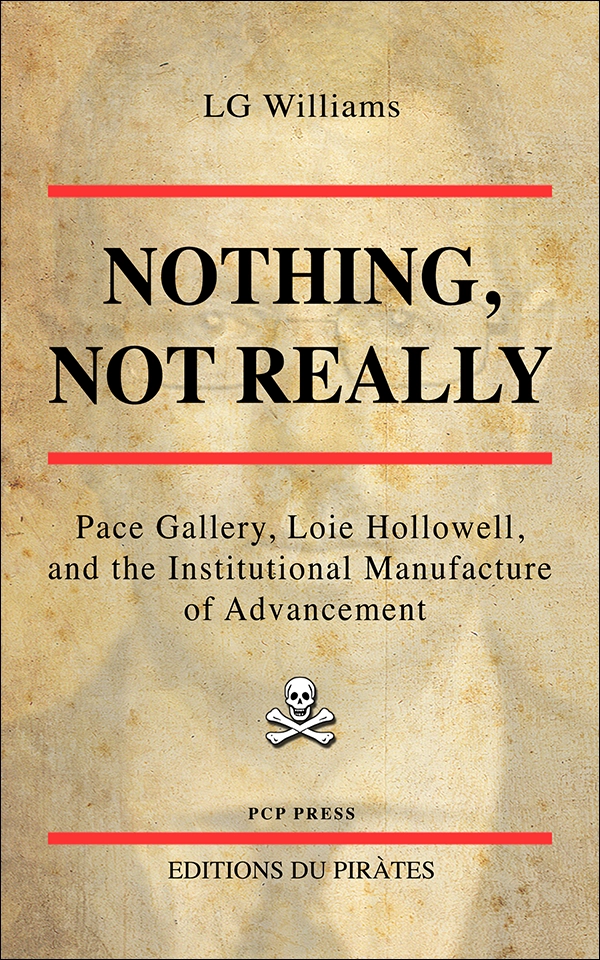
Book cover for Nothing, Not Really

Nothing, Not Really: Pace Gallery, Loie Hollowell, and the Institutional Manufacture of Advancement

AUTHOR / EDITOR / CONTRIBUTOR:
LG Williams

Description

Nothing, Not Really is an essay about Pace Gallery, its changing model of artistic authority, and the kind of art that model now rewards. Beginning with Pace’s expansion under Marc Glimcher and its 2026 contraction, LG Williams examines how a gallery once identified with artists who altered the terms of modern and contemporary art increasingly came to treat visibility, marketability, biography, and institutional circulation as evidence of advancement. Loie Hollowell becomes the central case through which that change is tested. Williams traces Hollowell’s work against a long history of artistic precedents, including Agnes Pelton, Sonia Delaunay, Zilia Sánchez, Robert Irwin, Judy Chicago, Ellsworth Kelly, and others.

Full Summary

Nothing, Not Really: Pace Gallery, Loie Hollowell, and the Institutional Manufacture of Advancement is a critical essay by LG Williams examining the relationship between artistic inheritance, institutional authority, market circulation, and claims of development in contemporary art. The essay begins with two inheritances: Arne Glimcher’s gallery passing to Marc Glimcher, and the visual discipline David Hollowell transmitted through his own painting and teaching. Loie Hollowell’s rise from Feuer/Mesler to Pace becomes the central case through which Williams tests what happens when recognizability, biography, circulation, and market success begin to stand in for artistic advancement. The book compares Hollowell’s formal vocabulary with precedents including Agnes Pelton, Sonia Delaunay, Zilia Sánchez, Robert Irwin, Judy Chicago, Ellsworth Kelly, Lynda Benglis, Robert Morris, Jackson Pollock, Cy Twombly, and others, distinguishing inheritance from assimilation, transgression, and surpassing. Williams argues that Hollowell repeatedly adopts already legible formal systems—symmetry, mandorlas, gradients, luminous discs, bodily protrusions, spectrum sequences, and shaped supports—while assigning them new autobiographical meanings such as abortion, pregnancy, birth, dilation, breastfeeding, and motherhood. A second line of argument examines whether autobiography functions as inquiry or as a protected source of meaning, using Seymour Howard and Ottessa Moshfegh as contrasting models of investigation that move beyond the self. The essay also analyzes the rhetoric of taboo and transgression, Pace’s own historical relation to artists such as Irwin and Benglis, Joel Mesler’s role in Hollowell’s early market positioning, and the broader institutional system through which visibility, curatorial endorsement, museum attention, and price can be converted into evidence of development. The final section returns to Pace’s 2026 contraction and Hollowell’s subsequent curatorial role at Pace Berlin, arguing that the mechanism has moved from individual artistic repetition to institutional reproduction: inherited achievements are stripped down to reusable devices, recirculated as lineage, and passed forward as models of advancement.

Contents

  1. I. Two Inheritances
  2. II. Inherited
  3. III. Absence
  4. IV. The Credential
  5. V. Taking the “I” Back
  6. VI. Nothing, Not Really
  7. Works Mentioned
  8. Index
  9. About The Author

Essay Summaries / Chapter Summaries