PCP Press Publication Catalogue
PCP PRESS
1996–2026
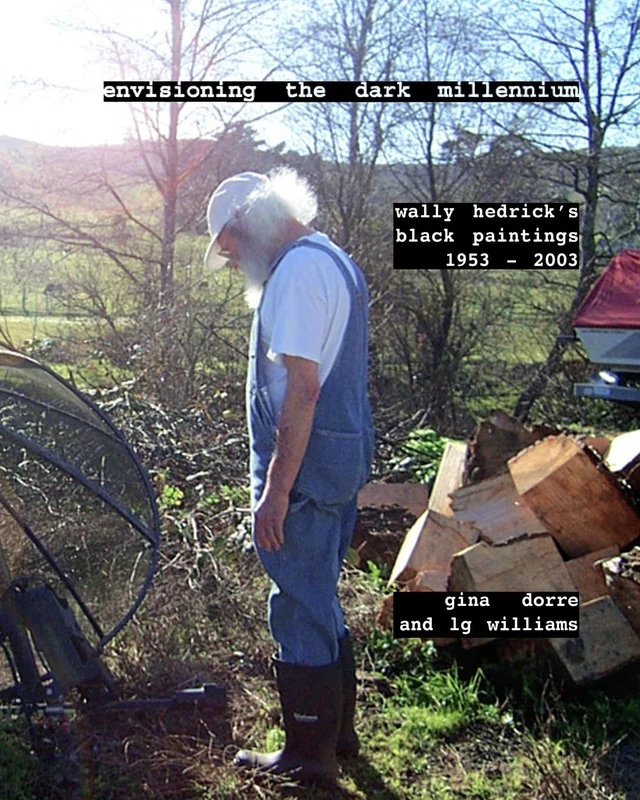
Book cover for Envisioning The Dark Millennium: Wally Hedrick's Black Paintings 1953 - 2003

Envisioning The Dark Millennium: Wally Hedrick's Black Paintings 1953 - 2003

AUTHOR / EDITOR / CONTRIBUTOR:
Gina Dorre and LG Williams with Rebecca Young Schoenthal, Kelly Young, Charles Linder, and Susan Truong

Description

Wally Hedrick's voice, a unique blend of truth and madness, resonates with the urgency of a prophet. His fiery denouncement of the world's evils and call for a return to humanity and spiritual enlightenment are unlike any other. His Black Paintings, emerging during the rise of the Unamerican Empire, mark a pivotal moment in history, a time of profound and radical changes that the old world struggles to navigate.

Amidst the revolutionary climate stoked by aggressive US militarism, Wally Hedrick stands as a beacon of vision. He guides those with a visionary outlook, akin to William Blake, to discern the signs of the contemporary apocalypse. It is when humanity is on the cusp of liberation, ready to rise and overthrow tyranny in its most appalling forms. As an artist and a mystic, Hedrick positions himself as a radical visionary, challenging the established order of his era.

Wally Hedrick, a figure profoundly out of step with his contemporaries, offers a stark opposition to the world around him. His isolation is deeply felt, yet it is in these times that his insights are most needed. Despite this, his voice remains unheard, highlighting a profound disconnect between his visionary perspective and the society he seeks to influence.

From the Back Cover

A PCP Press volume on Wally Hedrick's Black Paintings, foregrounding the works as anti-war, oppositional, and deeply connected to Bay Area art, Beat culture, and the history of postwar painting.

Full Summary

Envisioning The Dark Millennium: Wally Hedrick's Black Paintings: 1953 - 2003 brings together exhibition and critical texts on Hedrick's Black Paintings, a body of work associated with silence, withdrawal, anti-war imagery, and resistance to the institutional and political conditions of postwar American art. The book identifies the project with an exhibition at Linc Art in San Francisco and frames Hedrick as a central Bay Area figure whose work moves between Beat culture, political protest, black monochrome painting, satire, mysticism, and institutional critique.

The volume opens with front matter identifying Gina Dorre and LG Williams as editors and Rebecca Young Schoenthal, Kelly Young, Charles Linder, and Susan Truong as contributors. Charles Linder's text places Hedrick within San Francisco and postwar art history, emphasizing his difficult position as a well-known but often misunderstood painter. Rebecca Young Schoenthal's essay, For Service Rendered, reads the Black Paintings as a muting of earlier artistic statements, connects them to anti-war work and the War Room, and distinguishes Hedrick's black canvases from formalist monochrome painting by Ad Reinhardt and Robert Ryman. Gina Dorre's section uses a compressed field of terms around male power, violence, prejudice, war, sexism, revolt, and gendered force. The closing text by Kelly Young and LG Williams, Truth Or Madness, presents Hedrick as a prophetic and oppositional artist whose Black Paintings respond to militarism, empire, and social transformation.

Contents

  1. Front Matter
  2. Exhibition At Linc Art, San Francisco
  3. Things Should Be Large — Charles Linder, Linc Art
  4. For Service Rendered — Rebecca Young Schoenthal, University of Virginia
  5. Male/Power/Violence/Prejudice/War/Sexism/Revolt/Power/Female — Dr. Gina Dorre, Tulane University
  6. Truth Or Madness — Kelly Young And LG Williams, Kuhio Beach, Waikiki

Essay Summaries / Chapter Summaries

References / Press / Related Materials